


High-rise apartments and gated residential communities are the key application scenarios for ERV. In recent years, the newly-built high-rise apartments in Danglang are mostly of enclosed design. To isolate outdoor noise, dust, and humid hot air, the windows are mostly fixed or have small opening slats. The natural ventilation effect is poor, and the dense population of residents can easily lead to the accumulation of indoor CO₂, odors, and moisture. In summer, the energy consumption of air conditioners remains high. The ERV system can continuously exchange indoor and outdoor air while recovering the energy from the exhaust air, reducing the air conditioning load. It can also filter pollutants such as PM2.5 and pollen, improving the living comfort. It is particularly suitable for families with the elderly and children and tenants who pursue a healthy living environment. When installed, a small ceiling-mounted ERV unit can be used in combination with the ceiling space, adapting to the layout of the apartment.
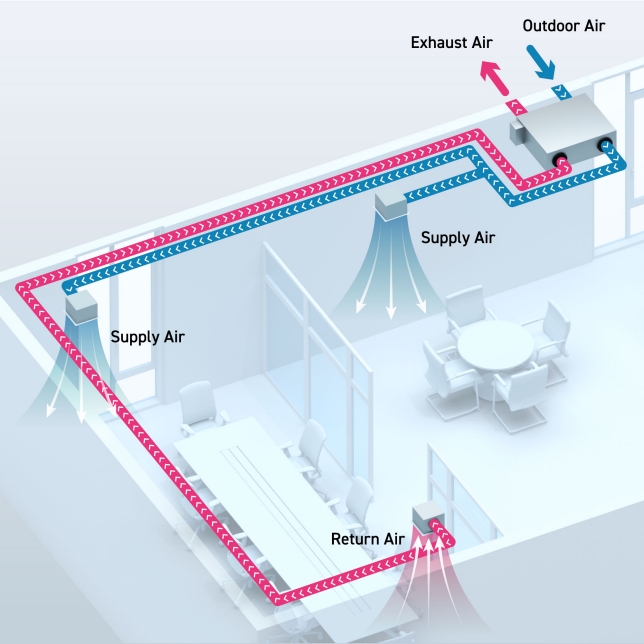
Large commercial complexes and office buildings also have a significant demand for ERV. The shopping centers and office buildings in Danglang mostly adopt closed-type central air conditioning systems. With dense populations and high equipment heat dissipation, the indoor concentrations of VOCs and CO₂ are prone to exceed the standards. Moreover, the long-term high-load operation of the air conditioning systems leads to high energy consumption costs. The ERV system can recover the cold and heat from the exhaust air through the full heat exchange core, reducing the cooling and heating loads of the air conditioning system, while stabilizing the supply of fresh air, improving the working efficiency of office personnel, reducing the operating costs of commercial buildings, and adapting to large ceiling-mounted ERV units. These units can be combined with the central air conditioning system for coordinated control to meet the ventilation and energy-saving requirements of large areas.
Industrial factories and storage facilities are important application scenarios for ERV systems. As a major industrial center, Danglang has factories for electronics, textiles, and food processing, which have strict requirements for indoor temperature and humidity as well as cleanliness. During production, heat, moisture, and a small amount of pollutants are generated. Traditional ventilation methods often lead to energy waste and environmental fluctuations. The ERV system can remove polluted air while recovering energy, maintaining a stable indoor temperature and humidity environment, reducing dehumidification and air conditioning energy consumption. It is particularly suitable for production processes that are sensitive to temperature and humidity, such as electronic component production workshops and food storage areas. The floor-standing or ceiling-mounted ERV units can be selected based on the size of the factory, and the air volume and filtration grade can be customized according to process requirements.
Medical and educational institutions have extremely high requirements for indoor air quality, making them suitable for the application of ERV systems. Danglang's hospitals, clinics, schools, etc. have high personnel mobility, are prone to cross-infection, and require fresh and comfortable indoor air. The ERV system can provide continuous fresh air supply, filter out bacteria and dust in the air, and simultaneously recover energy to reduce operating costs. ERV systems can be installed in areas such as hospital wards, operating rooms, school classrooms, and laboratories. Based on the specific needs of the venues, units with high-efficiency filtration functions can be selected to enhance the safety of the indoor environment.
Hotels and dining establishments can also enhance service quality and energy-saving effects through the ERV system. In the hotel rooms, restaurants, kitchens and other areas of Danglang, there are many people and they tend to produce odors, smoke and moisture. Traditional ventilation methods are prone to waste energy and cause poor environmental conditions. The ERV system can effectively remove odors and moisture, recover the energy from the exhaust air to reduce the energy consumption of air conditioning, and in the kitchen area, a dedicated exhaust system can be combined with the ERV unit to improve ventilation efficiency and reduce the impact on the surrounding environment. Hotel rooms can use wall-mounted or small ceiling-mounted ERV units, while restaurants and kitchens need to select appropriate units with the right air volume according to the size of the space.
 18705226241


