


Net‑Zero Building HVAC Strategies for Sustainable Construction
Net-zero energy buildings have rapidly evolved from a futuristic sustainability concept to a global construction standard. Defined as structures that produce at least as much renewable energy as they consume annually, net-zero buildings drastically cut operational carbon emissions, lower long-term utility costs, and align with international carbon neutrality goals. In sustainable construction, HVAC systems stand out as the largest energy consumer, typically accounting for 40% to 60% of a building’s total energy use. This means HVAC design is the make-or-break factor for achieving genuine net-zero performance. This blog explores practical, industry-proven net-zero building HVAC strategies, covering passive optimization, high-efficiency active systems, renewable energy integration, and smart operational controls for both residential and commercial sustainable construction projects.
Unlike conventional HVAC design that focuses solely on thermal comfort, net-zero HVAC strategies follow a strict“demand reduction first, renewable offset second” workflow. The core logic is simple: you cannot achieve net-zero by simply adding renewable power to inefficient systems. Successful net-zero buildings prioritize minimizing heating, cooling, and ventilation loads through passive building design before deploying active HVAC equipment and renewable energy systems. Every design decision must balance indoor air quality (IAQ), thermal comfort, energy efficiency, and carbon reduction to meet strict net-zero certification standards including LEED Zero, ILFI Zero Energy, and national net-zero building codes.
Passive design is the foundation of all net-zero HVAC strategies, delivering permanent energy load reductions without relying on mechanical equipment or ongoing power consumption. It eliminates excessive HVAC demand and allows right-sized, high-efficiency mechanical systems to operate optimally year-round.
A tightly optimized building envelope minimizes thermal transfer and eliminates energy waste. Key upgrades include high-R-value continuous insulation, low-emissivity (low-e) double or triple glazing, thermally broken window and door frames, and airtight construction. Strict airtightness control reduces uncontrolled air infiltration, which is responsible for up to 30% of building HVAC load fluctuations. Additionally, strategic building orientation, external shading fins, and green façades reduce solar heat gain in summer and maximize passive solar heating in winter, stabilizing indoor temperatures naturally.
Leveraging cross ventilation, stack ventilation, and solar chimney designs delivers consistent fresh air circulation during mild seasons, reducing reliance on mechanical ventilation. For temperature stabilization, phase-change materials (PCMs) embedded in walls and ceilings absorb excess heat during daytime and release it at night, flattening indoor temperature peaks and cutting peak cooling and heating loads significantly. These passive measures reduce overall HVAC energy demand by 25–40% for most commercial and residential net-zero projects.
After minimizing passive loads, selecting right-sized, ultra-efficient active HVAC equipment is critical to lowering operational energy use. Net-zero design strictly rejects oversized conventional systems, as part-load operation leads to massive energy waste and unstable efficiency.
Heat pumps replace fossil fuel-based furnaces and boilers as the primary heating and cooling solution for net-zero buildings. Modern air-source heat pumps offer a COP of 3.0–4.5, while geothermal heat pumps (GHPs) deliver an exceptional COP of 4.0–6.0 by utilizing stable underground soil temperatures. Geothermal systems reduce HVAC electricity consumption by 30–60% compared to traditional air-source equipment, making them ideal for large-scale commercial net-zero construction. Inverter-driven variable-capacity technology allows heat pumps to modulate output precisely matching real-time thermal loads, avoiding energy waste from frequent start-stop cycles.
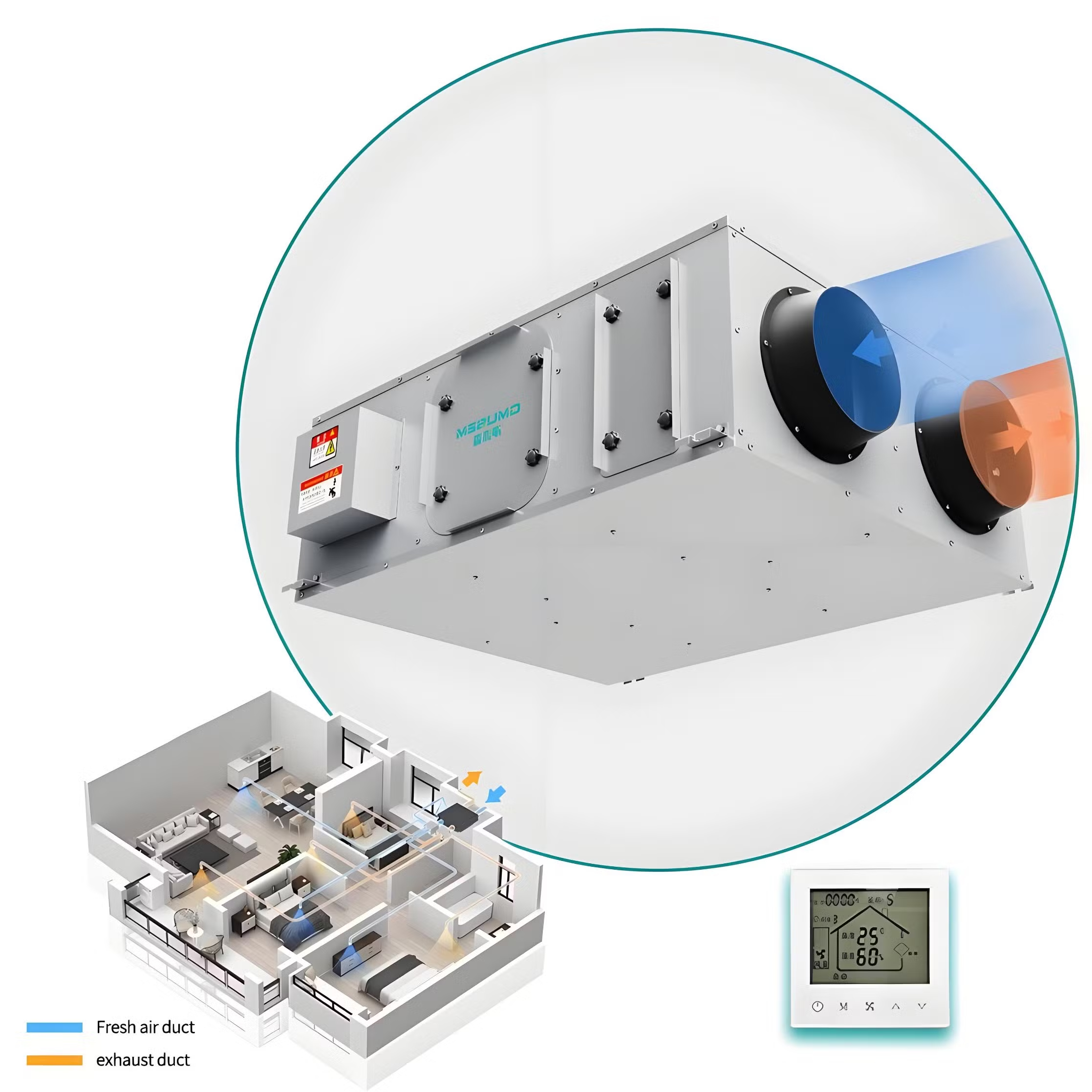
Energy Recovery Ventilators (ERVs) and Heat Recovery Ventilators (HRVs) are mandatory for airtight net-zero buildings. These systems transfer heat and moisture between exhausted stale air and incoming fresh air, pre-conditioning ventilation air and cutting ventilation energy loads by 60–80%. Unlike standard ventilation fans, ERVs maintain balanced indoor humidity and consistent IAQ while eliminating the energy penalty of continuous fresh air exchange, perfectly matching the low-energy demands of net-zero design.
VRF systems enable independent temperature control for different building zones, solving the energy waste issue of whole-building conditioning. With precise capacity modulation, VRF systems maintain optimal efficiency during partial-load conditions, which account for over 80% of annual building operation time. This technology delivers 30–50% higher seasonal efficiency than conventional central HVAC systems, making it a staple for modern net-zero office buildings, multi-family residences, and mixed-use structures.
Net-zero buildings require on-site or near-site renewable energy generation to offset all remaining HVAC and building operational energy use. Seamless integration between HVAC systems and renewable energy grids is the final step to achieve annual energy balance.
Roof-mounted solar photovoltaic (PV) systems generate clean electricity to power heat pumps, ventilation fans, and smart HVAC controls. For enhanced efficiency, photovoltaic-thermal (PVT) systems co-produce electricity and usable thermal energy from the same roof area. The captured heat can support domestic hot water systems and low-temperature space heating, while generated electricity powers electrical HVAC components, maximizing energy output per square meter of building footprint.
Thermal storage tanks and phase-change thermal batteries store excess renewable heat or off-peak cooling energy for peak-hour use. This strategy shifts HVAC energy consumption from high-grid-cost, high-carbon peak periods to low-carbon renewable energy periods, eliminating peak energy demand and enabling full utilization of intermittent solar power. Storage systems stabilize HVAC operation and ensure the building maintains a true annual net-zero energy balance.
Even the most efficient hardware fails to deliver net-zero performance without intelligent operational management. Smart HVAC controls eliminate unnecessary energy consumption through data-driven, demand-responsive operation.
DCV systems use CO₂ and occupancy sensors to adjust ventilation rates based on real-time indoor occupancy. In intermittently occupied spaces such as offices, classrooms, and conference rooms, DCV reduces ventilation energy use by 15–30% compared to fixed-rate ventilation systems, avoiding energy waste in unoccupied zones while preserving healthy IAQ.
Building Management Systems (BMS) centralize HVAC monitoring and zoning control, while AI-powered predictive algorithms analyze weather forecasts, indoor occupancy patterns, and historical energy data to pre-adjust HVAC operation. The system pre-cools or pre-heats the building during low-load, high-renewable-energy periods and minimizes operation during peak demand, optimizing seasonal energy performance and eliminating human-operation-related energy waste.
Over-reliance on active efficiency: Skipping passive envelope optimization and solely upgrading HVAC equipment leads to unachievable net-zero targets and inflated operational costs.
Oversized HVAC equipment: Over-sizing reduces seasonal efficiency, increases cycling loss, and fails to match the low-load characteristics of high-performance net-zero envelopes.
Disconnected renewable and HVAC systems: Lack of coordinated energy scheduling results in wasted renewable generation and unbalanced annual energy budgets.
Ignoring ventilation energy load: Uncontrolled mechanical ventilation becomes a major hidden energy drain that breaks net-zero energy balance.
Net-zero building HVAC design is a systematic, integrated strategy rather than a single technical upgrade. It relies on layered optimization: passive envelope load reduction lays the foundation, high-efficiency active HVAC equipment cuts operational consumption, renewable energy systems offset residual energy use, and smart controls ensure long-term optimal performance. For modern sustainable construction, mastering these HVAC strategies is essential to obtaining net-zero certification, reducing carbon footprints, and delivering resilient, comfortable, and future-proof buildings. As global sustainable building standards continue to tighten, integrated net-zero HVAC design will become the universal benchmark for new construction and major retrofits worldwide.
 18705226241


