


Industrial Fresh Ventilation System Solutions Journal
For industrial and commercial facilities, air quality management is far more than a matter of comfort — it is a core part of workplace safety, production stability, equipment protection, and regulatory compliance. Manufacturing plants, processing workshops, warehouses, chemical laboratories, and industrial storage areas constantly generate dust, oil mist, chemical volatile organic compounds (VOCs), exhaust gas, and excess moisture. Without professional and targeted ventilation solutions, these pollutants will accumulate indoors, leading to reduced staff productivity, increased equipment corrosion, degraded product quality, and even potential safety and health hazards.
Many facility managers attempt to apply residential ventilation equipment to industrial spaces, only to face insufficient air exchange, rapid filter clogging, high energy consumption, and poor long-term stability. Industrial environments feature large space volumes, continuous pollution generation, and strict operational standards, which require customized industrial fresh ventilation system solutions. This journal-style article systematically analyzes the pain points, core advantages, applicable scenarios, and key selection criteria of industrial fresh ventilation systems, providing practical references for HVAC engineers, factory operators, and industrial property managers.
Unlike sealed residential rooms with minor air pollution, industrial sites pose harsh and complex ventilation challenges that standard ventilation products cannot solve effectively. First, industrial spaces cover large areas with high ceilings, requiring high-volume, stable, and long-duration air circulation to meet standardized air change rates. Ordinary ventilation units with low air output fail to dilute indoor pollutants in time, resulting in persistent stale air.
Second, industrial pollution sources are diverse and corrosive. Metal cutting dust, paint fumes, chemical exhaust, industrial oil mist, and ammonia gas from breeding industries are not only harmful to the human respiratory system but also corrosive to ventilation equipment. Conventional household filters and ordinary fan structures are easily damaged and clogged, leading to frequent equipment failures and short service life.
Third, industrial operation pursues long-term cost control. Most factories and workshops operate 24/7. Uncontrolled natural ventilation or non-energy-saving mechanical ventilation will cause massive loss of heating and cooling energy, greatly increasing annual operational costs. In addition, industries such as precision manufacturing, pharmaceuticals, and laboratory testing have strict requirements for constant temperature and humidity, which further raises the threshold for industrial ventilation systems.
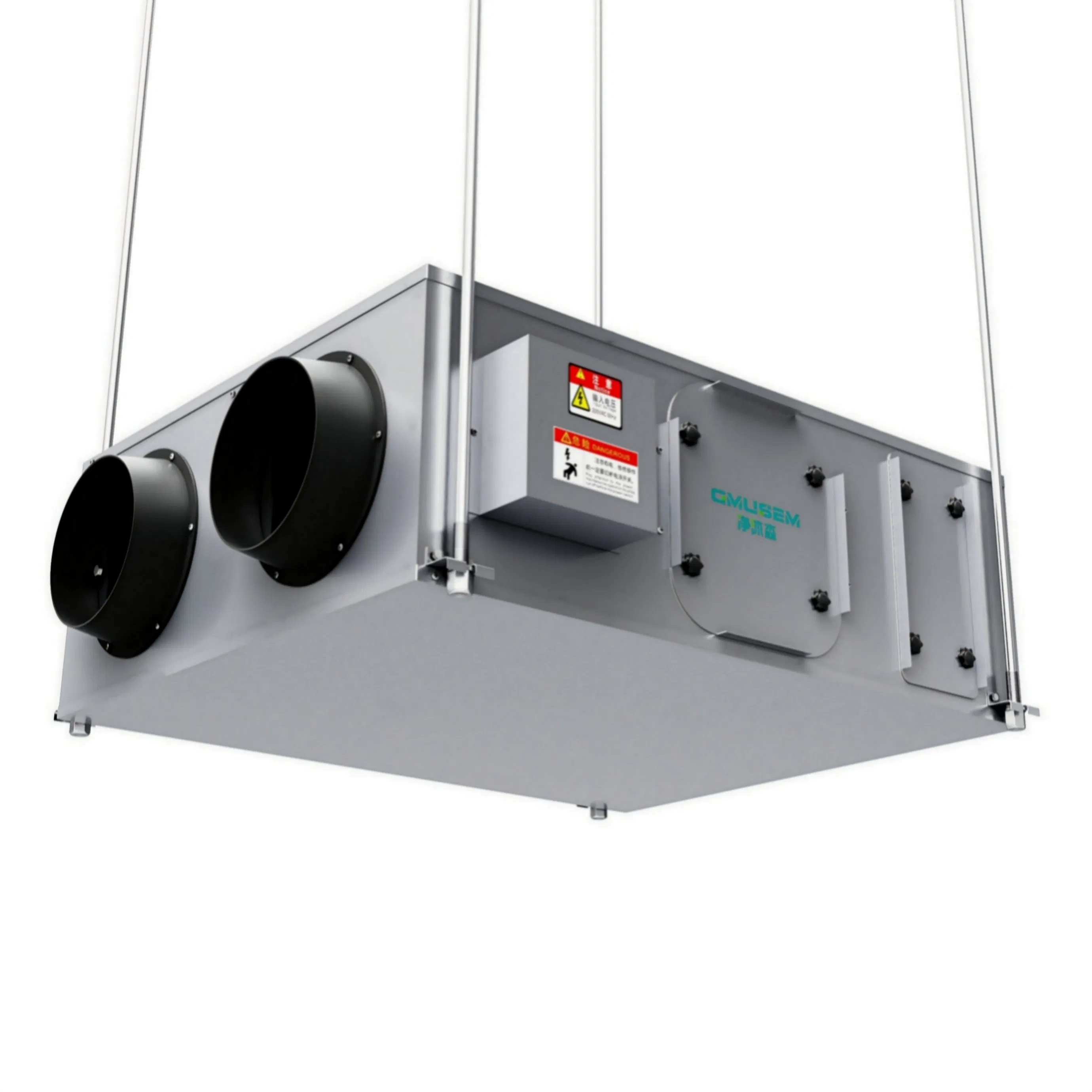
Professional industrial fresh ventilation systems adopt customized multi-stage filtration solutions tailored to different industrial pollutants. Equipped with primary efficiency filters, medium-efficiency particulate filters, high-efficiency activated carbon filters, and anti-corrosion filter cabins, the systems can effectively intercept industrial dust, fine particulate matter, oil mist, peculiar odors, and toxic volatile gases. For chemical, spraying, and metallurgical industries with strong corrosive gases, the whole machine and air ducts adopt stainless steel and anti-corrosion coatings, which greatly enhance durability and adaptability to harsh working conditions, avoiding frequent replacement of accessories and equipment downtime losses.
Energy recovery is one of the most valuable designs of industrial ventilation systems. Built with high-performance heat and humidity exchange cores, the equipment can recover more than 75% of indoor temperature energy while exchanging indoor and outdoor air. In winter, it preheats cold outdoor fresh air through exhausted indoor warm air; in summer, it cools down high-temperature outdoor air with indoor cold air. This design avoids sharp temperature fluctuations in the workshop, reduces the load on industrial air conditioners and heating equipment, and cuts long-term energy consumption and operational costs for enterprises. It perfectly balances efficient ventilation and energy-saving operation.
Industrial fresh ventilation solutions support flexible customized design according to factory layout, production process, and pollution degree. Centralized large-air-volume ventilation systems are suitable for full-coverage ventilation of large workshops and warehouses; independent cabinet-type and wall-mounted ventilation units are applicable for small workshops, testing rooms, and control rooms with independent air quality requirements.
Matched with intelligent PLC control systems, the equipment supports zoned air volume adjustment, timed operation, and real-time monitoring of indoor CO₂ concentration, PM value, and humidity. The system can automatically adjust ventilation intensity according to production status and air quality changes, realizing precise, intelligent, and unmanned ventilation management.
Industrial ventilation equipment is professionally optimized for long-hour continuous operation. Equipped with high-power silent industrial fans with overload protection, waterproof and dustproof IP-rated casing, and high-temperature resistant structural materials, it can stably operate around the clock in high-dust, high-humidity, and high-temperature industrial environments. Compared with civilian equipment, it has lower failure rate, longer service life, and stronger operational stability, meeting the uninterrupted production needs of industrial enterprises.
Mechanical processing, woodworking, textile, and food processing workshops generate a large amount of dust and floating debris. Industrial fresh ventilation systems continuously discharge particulate pollutants, maintain sufficient indoor oxygen content, improve the working environment of employees, and meet national occupational health and safety production standards.
Closed warehouses are prone to excessive humidity, mold growth, and stale air, which will dampen and damage raw materials and finished products. Constant air circulation provided by ventilation systems reduces indoor humidity, eliminates musty odors, and protects the storage quality of industrial materials and goods.
Chemical laboratories and pharmaceutical production areas have extremely strict requirements for air cleanliness and volatile gas control. High-efficiency filtration and constant ventilation functions can effectively dilute and discharge chemical residues and harmful volatiles, meeting the purification ventilation standards of clean industrial spaces.
Breeding bases are prone to high concentration of ammonia, moisture, and peculiar odors. Professional negative-pressure ventilation solutions can quickly exhaust harmful gases, reduce bacterial breeding, and improve the breeding environment, realizing standardized and healthy industrial breeding.
The effectiveness of industrial ventilation depends on scientific solution design rather than blind equipment stacking. When selecting solutions, facility managers need to comprehensively consider the factory area, airtightness, pollution type, personnel density, and production characteristics to determine the air change rate, equipment power, and filtration grade. Excessively low configuration leads to poor ventilation effect, while excessive configuration causes waste of energy and cost.
In terms of daily maintenance, regular replacement of filter elements, cleaning of air ducts and heat exchange cores, and inspection of fan operating status are essential. Timely maintenance can ensure long-term efficient operation of the system, reduce failure rates, and extend the service life of industrial ventilation equipment.
Industrial fresh ventilation systems are indispensable core equipment for modern industrial intelligent and green production. Different from civilian ventilation products, industrial customized solutions take safety, efficiency, energy saving, and stability as the core, solving various air environment problems in complex industrial scenarios. A scientific and reasonable industrial ventilation system can not only standardize production safety and protect employee health but also reduce enterprise operational costs, improve product quality, and create a long-term stable and high-quality industrial production environment.
 18705226241


