


HVAC Ventilation: Balance Comfort, Health and Energy Savings
Many building decisions feel like a compromise. Want fresh air? Open the windows and watch your heating bill climb. Want a comfortable temperature? Seal the room and the air quickly becomes stale, humid and unhealthy. For decades, comfort, health and energy savings have been treated as three competing goals. Modern HVAC ventilation proves they do not have to be. A well-designed ventilation system is the engineering link that lets you enjoy all three at once — here is how.
Most people have experienced one of three unsatisfying scenarios. A room that feels perfectly warm but stuffy, where concentration drops and headaches appear after an hour. A room that feels cool and fresh but drafty, with cold spots and noisy fans. Or an energy-efficient, tightly sealed home where mold, condensation and lingering odors quietly take over.
Each scenario optimizes one goal at the expense of the others. The real question is not which single goal to prioritize, but how to design the system so that comfort, health and energy efficiency reinforce each other instead of fighting.
Goal | What it actually means | How ventilation delivers it |
|---|---|---|
Comfort | Stable temperature, balanced humidity, no drafts, quiet operation | Balanced supply and extraction, tempered air, insulated ductwork |
Health | Low CO₂, controlled pollutants and allergens, dry surfaces | Controlled fresh air exchange + filtration (G4 to H13 HEPA) |
Energy savings | Minimal waste from conditioning outdoor air | Heat/energy recovery (HRV/ERV), demand-controlled, efficient fans |
Thermal comfort is often reduced to thermostat temperature, but people actually judge comfort by a combination of factors: air temperature, relative humidity, air movement and the absence of drafts. A balanced ventilation system supplies fresh air at a rate matched to the room, and — crucially — it pre-treats that air before it reaches you.
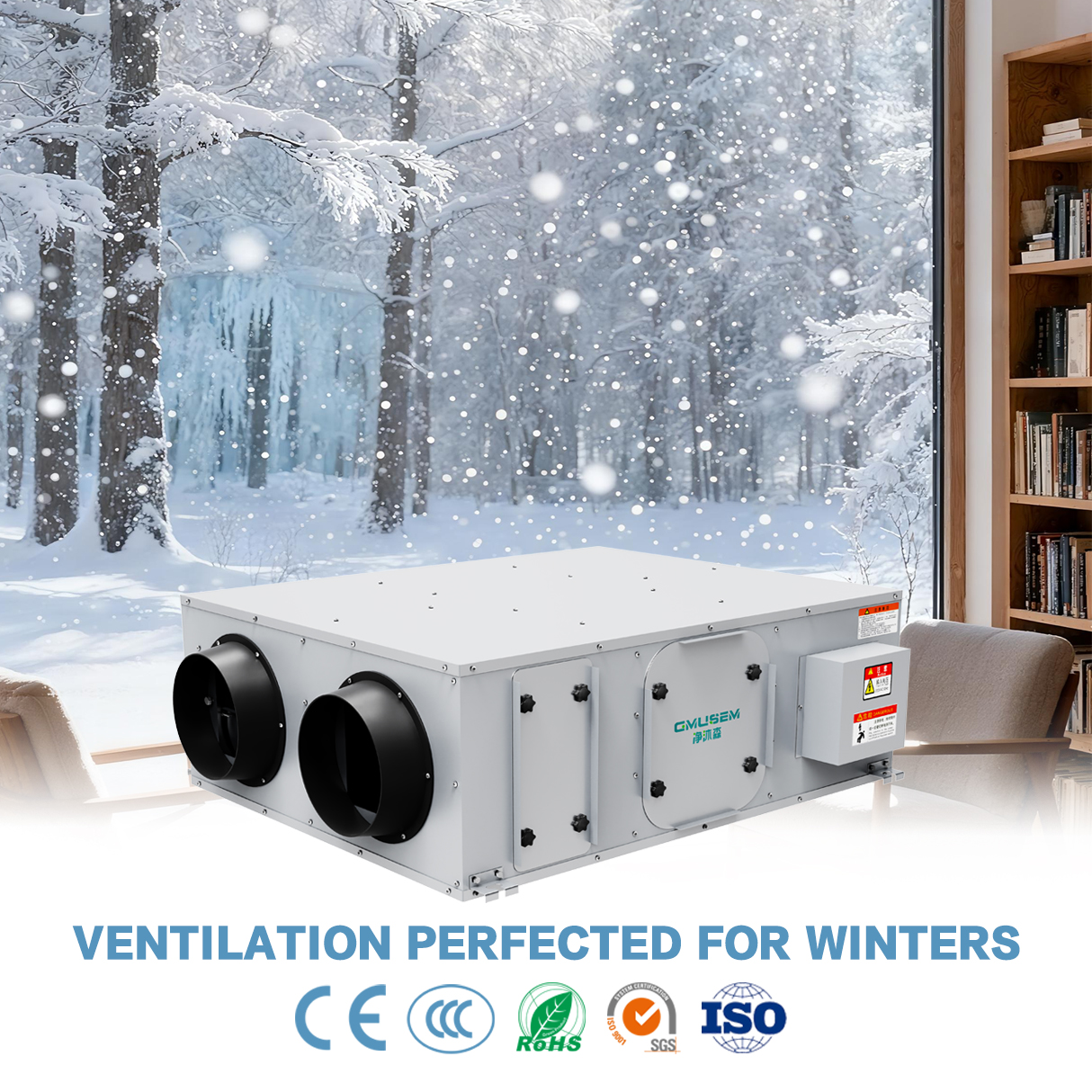
In winter, incoming fresh air is warmed by the heat recovery core rather than arriving as a cold blast. In summer, an Energy Recovery Ventilator (ERV) can also moderate humidity. Insulated, Rockwool-lined ductwork and properly sized fans keep the system quiet, so comfort does not come at the cost of background noise. The result is a room that feels evenly comfortable, hour after hour.
Healthy indoor air is about two things: bringing in enough fresh air, and removing the right contaminants. As people breathe, carbon dioxide builds up; cooking, cleaning, furniture and building materials release volatile organic compounds; dust, pollen and moisture accumulate. Without controlled ventilation, these pollutants reach uncomfortable and eventually unhealthy levels.
A balanced system addresses both sides of the equation. It supplies filtered outdoor air — with filter grades chosen for the local environment, up to H13 HEPA where dust, allergens or hygiene matter most — and extracts stale, moist air precisely from the rooms that need it, such as kitchens and bathrooms. Controlling humidity also prevents the damp conditions in which mold and dust mites thrive. The payoff is fewer headaches, better concentration and long-term respiratory health.
The biggest energy cost of ventilation is not moving the air — it is conditioning it. Heating cold outdoor air to room temperature, or cooling it in summer, is expensive. This is why heat recovery is the single most important technology for balancing fresh air with efficiency.
A Heat Recovery Ventilator (HRV) transfers up to 90% of the heat from outgoing stale air to the incoming fresh air stream, while an Energy Recovery Ventilator (ERV) also exchanges some moisture. In practice, this means you keep the health benefit of continuous fresh air while avoiding the energy penalty of treating all that air from scratch. Add in efficient EC fans, demand-controlled ventilation that adjusts airflow to actual occupancy, and Modbus RS485 smart controls that prevent over-ventilating empty rooms, and the system costs far less to run than most homeowners expect.
Achieving this balance is not accidental — it comes from design decisions made early in the project.
Right-size the airflow. Undersized units sacrifice health; oversized units waste energy and create drafts. Calculate airflow from the room area, number of occupants and expected pollutants.
Specify heat recovery. In any climate with a heating or cooling season, HRV/ERV is the fastest route to reconciling fresh air with energy savings.
Choose the right filter grade. Match filtration to real indoor and outdoor air quality; upgrade to HEPA where allergies, dust or hygiene are concerns.
Insulate the ductwork. Insulated, acoustic ductwork prevents condensation, heat loss and noise — the quiet, comfortable kind of ventilation Add smart, demand-based control. Modbus RS485-compatible units and sensors modulate airflow by occupancy and indoor air quality, so the system ventilates hard when needed and gently when it does not.Balance supply and extraction. Pressurizing or depressurizing a building incorrectly creates drafts, back-drafting and discomfort. A balanced system is the foundation of all three goals.
The key insight: Comfort, health and energy savings are not a triangle you have to choose between. Controlled fresh air plus heat recovery plus smart control is what turns three competing goals into one efficient, comfortable, healthy system.
Good HVAC ventilation does not force you to choose between a warm room, fresh air and a low energy bill. By combining balanced air exchange, heat and energy recovery, proper filtration and intelligent, demand-based control, a modern system delivers stable comfort, healthier indoor air and measurable savings at the same time. The trade-offs most people accept are actually design problems — and they are solvable.
Whether you are planning a comfortable low-energy home, upgrading a commercial space or specifying ventilation for an industrial project, the same principles apply. Talk to our HVAC engineering team about HRV/ERV units, efficient fan systems and Modbus-controlled ventilation solutions tuned to your project — and stop choosing between comfort, health and efficiency.
 18705226241


