


Flexible Ducting Ventilator: A Complete Buyer's Guide (2026)
A flexible ducting ventilator looks simple on paper — a fan wrapped in insulation inside a flexible tube — but buying the wrong one quietly costs you for years: a unit that is too small leaves bathrooms damp, a unit that is too large wastes energy, and a unit with a cheap motor rattles through the ceiling above your bedroom.
This buyer's guide walks through every specification that matters, the trade-offs between budget and premium models, and the questions you should ask any supplier before you place an order. It is written for HVAC contractors, MEP specifiers, procurement managers, and building owners who want to specify the right unit the first time.
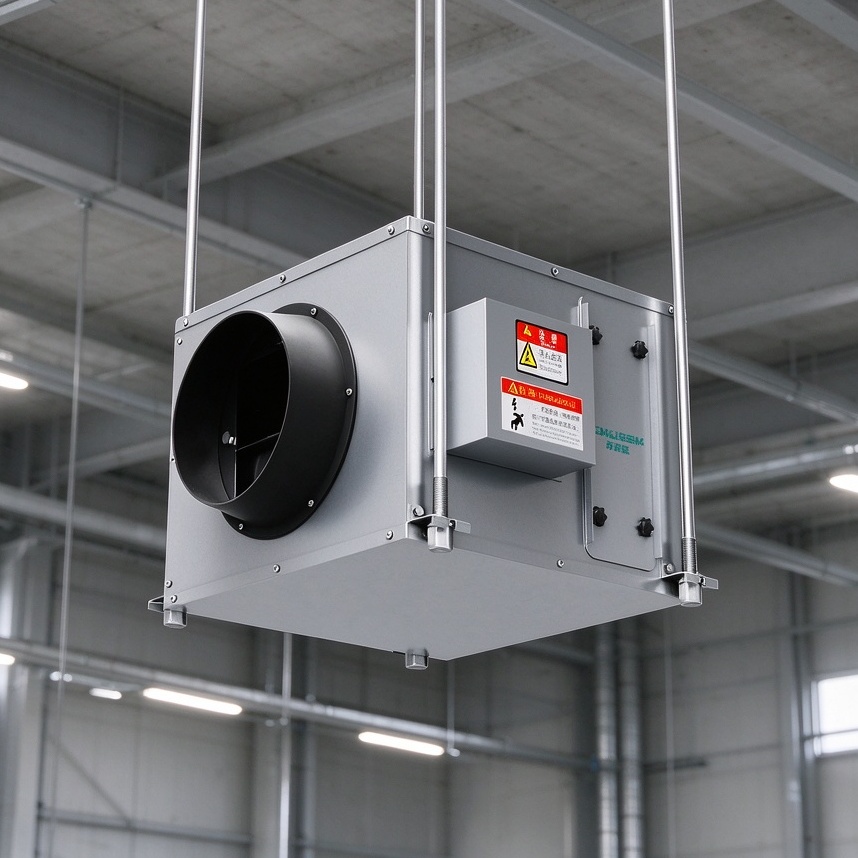
A flexible ducting ventilator (also called an in-line duct fan, mixed-flow duct fan, or flexible duct booster) is a blower installed in line with flexible ductwork to either supply fresh air or exhaust stale air. Its flexible body bends around joists and beams, and the integral insulation reduces both condensation and noise break-out.
Before you compare prices, confirm the role the unit will play:
Supply fan: pulls outdoor air into the building (often feeding an HRV/ERV or a single room).
Exhaust fan: pushes humid or contaminated air out (bathroom, kitchen, crawl space).
Booster fan: mounted in a branch of an HRV/ERV system to overcome long duct runs.
Commercial exhaust: grease-laden kitchen air, fume extraction, warehouse ventilation.
The role determines which specifications you should weight most heavily.
This is the headline number, but it is also the most misleading. A fan rated at 300 CFM on the box rarely delivers 300 CFM once it is connected to ductwork. Always ask the supplier for the fan curve — airflow plotted against external static pressure (ESP).
Rule of thumb for sizing:
Bathroom: 5–8 air changes per hour (ACH), typically 75–150 m³/h (45–90 CFM).
Kitchen recirculation boost: 150–400 m³/h depending on hood size.
HRV/ERV branch booster: match the main unit's branch rating, usually 100–250 m³/h.
Commercial office demand-controlled ventilation: 25–36 m³/h per person.
ESP is the resistance the fan has to overcome — duct friction, bends, grilles, filters, and the HRV/ERV heat exchanger. A cheap fan with a high CFM rating at zero pressure may deliver half that airflow at 50 Pa.
For most residential installs, target a fan that delivers your required CFM at 40–80 Pa. For commercial runs with filters, heat recovery, and long ductwork, look at 100–200 Pa.
This is the biggest split in pricing and lifetime cost.
Shaded-pole AC (budget): cheapest, least efficient (20–30% efficiency), fixed speed, rated for intermittent use. Fine for a bathroom fan that runs 20 minutes a day.
Capacitor-run AC (mid-range): better efficiency (40–50%), quieter, rated for longer duty cycles. Common in ducted kitchen and HRV booster applications.
EC / DC (premium): 65–80% efficient, fully speed-controllable via 0–10 V, Modbus RS485, or PWM, rated for 24/7 continuous duty. For commercial buildings, passive houses, and smart ventilation systems, EC pays back in energy savings within 2–4 years.
If the unit runs more than 4 hours a day, specify EC. If it runs only for short bathroom exhaust cycles, a quality AC motor is acceptable.
Noise is where the cheapest units fail. Two numbers matter:
Sound power level (LwA), in dB(A): the total noise emitted by the fan.
Sound pressure level (LpA) at 1.5 or 3 m: what you actually hear in the room below.
Target LpA below 35 dBA for bedrooms and quiet offices. Kitchens and commercial spaces can tolerate 40–50 dBA. Always ask for the noise curve at the operating point, not the marketing brochure number at zero airflow.
Acoustic-lined ductwork (perforated inner liner with rock-wool) reduces noise by 5–10 dBA compared with plain flexible duct — worth it in bedrooms and meeting rooms.
Insulation prevents condensation on the outside of the duct (which otherwise drips on the ceiling) and reduces noise break-out.
25 mm glass wool: entry level, adequate for warm climates.
25–50 mm rock wool: better acoustic performance, slightly more rigid, fire-resistant. Preferred in commercial and passive-house projects.
Vapour barrier: always require an aluminium foil outer layer — without it, insulation absorbs moisture and loses performance within a year.
Standard sizes are 100 mm (4"), 125 mm (5"), 150 mm (6"), 200 mm (8"), 250 mm (10"), and 315 mm (12.5"). Pick the diameter that matches the rest of your ductwork — reducing or enlarging at the fan causes turbulence, noise, and pressure loss.
As a rough guide, 100–125 mm suits single bathrooms; 150 mm suits kitchens and HRV branches; 200 mm and above serve commercial spaces and large fresh-air runs.
For wet, dusty, or outdoor-mounted units, check the motor and terminal box IP rating.
IP44: standard indoor bathroom installations.
IP54 / IP55: commercial kitchen, garage, outdoor discharge — preferred for harsh environments.
Also look for thermal overload protection (automatic reset) and, for kitchen exhaust, a heat-resistant impeller rated for 60°C or higher.
What you can connect the fan to determines its intelligence:
On/off only: basic, wired to a switch or timer.
Speed control input: 0–10 V or triac, allowing manual or sensor-based modulation.
Modbus RS485: BMS integration for commercial projects — fan status, runtime, fault alarms, and variable speed from the building management system.
Sensor-ready: can accept humidistat, CO₂, or occupancy sensors for demand-controlled ventilation.
Pricing for flexible ducting ventilators varies widely by diameter, motor, and features. As a rough 2026 benchmark (ex-works, FOB Chinese port):
Entry level (100–150 mm, AC shaded-pole, no acoustic liner): $15–$40. Fine for occasional bathroom exhaust in DIY or budget housing. Expect a shorter motor life and higher noise.
Mid-range (125–200 mm, capacitor-run AC, 25 mm insulation, thermal protection): $40–$120. The sweet spot for most residential and light-commercial projects — reliable, reasonably quiet, 5–8 year motor life.
Premium EC (100–315 mm, EC motor, acoustic liner, 0–10 V or Modbus, IP54/55): $120–$400+. For commercial, passive-house, hotel, and smart-building projects. Lower energy use, longer life (10+ years), and BMS-ready controls.
The cheapest unit is rarely the cheapest when you factor in energy use, noise complaints, and early motor replacement.
When comparing suppliers, walk away if you see any of these:
No fan curve — only a maximum CFM number. You cannot size the unit without it.
No noise data at the operating point, or noise measured at 1 m instead of 1.5 m.
Insulation described vaguely — ask for thickness (mm), material (glass wool vs rock wool), and density (kg/m³).
Motor not specified — ask for brand (e.g., Ebm-papst, Ziehl-Abegg, or domestic equivalent), rated watts, RPM, and insulation class (B or F).
No thermal protection on the motor.
Warranty shorter than 2 years — reputable suppliers offer 2–5 years on AC and 5 years on EC motors.
Impeller material unclear for kitchen exhaust — must be heat-resistant and grease-tolerant.
Send this checklist to every quote you receive:
Can you provide the full fan curve (CFM vs static pressure) for this model?
What is the sound pressure level (dBA) at 1.5 m at my operating point?
What motor brand is used? Is it AC or EC? What is the rated input power and RPM?
What is the insulation thickness, material, and density? Is there an acoustic liner?
What is the IP rating of the motor and terminal box?
Does the unit support speed control? What protocol (0–10 V, Modbus, triac)?
What diameter and length is the flexible section? Are jubilee clips or mounting brackets included?
What certifications are available (CE, RoHS, ETL, UKCA, ISO)?
What is the warranty period, and what is covered (motor, impeller, housing, electronics)?
What is the lead time for sample orders and container quantities?
Even the best fan underperforms if installed wrong. Before you order, confirm:
There is enough void space in the ceiling or loft for the unit plus straight duct on both sides (at least 3–5 duct diameters).
The duct run can slope toward the exterior so condensate drains outward, not back into the fan.
You have access to a switched live or control cable for the motor.
The external wall grille or roof termination is included in your duct resistance calculation.
Filters (if used) are accessible for cleaning — a blocked filter silently kills airflow.
A well-maintained flexible ducting ventilator should last:
AC motor, residential: 5–8 years.
EC motor, commercial: 10–15 years.
To hit that lifespan:
Clean or replace filters every 6–12 months.
Inspect the impeller for dust and grease build-up annually.
Check that the flexible duct is not crushed or sagging, which restricts airflow.
Verify the insulation vapour barrier has not been punctured during installation.
No. An oversized fan runs inefficiently, generates more noise, and shortens its own life. Size it on the fan curve for your actual duct resistance — not on gut feeling.
For a bathroom that runs 10–20 minutes a day, usually not. The energy savings do not justify the premium. EC becomes worthwhile when the fan runs continuously or for long daily cycles (HRV/ERV branches, commercial offices, kitchen exhaust).
For EU and UK markets, CE and UKCA are the baseline. For the US and Canada, look for ETL or UL listing. For Australia, RCM. Ask the supplier which certificates they can provide for your destination — and request a copy before ordering.
Standard models are usually in stock and ship within 7–15 days. Custom EC models, special diameters, or private-label branding typically take 30–45 days for container orders.
For small quantities (under 50 units), a local wholesaler gives faster support and easier returns. For project quantities (50+ units) or custom branding, direct factory sourcing cuts cost by 20–40% — but verify certifications, fan curves, and warranty terms in writing.
Buying a flexible ducting ventilator is not about picking the highest CFM or the lowest price. It is about matching the fan curve to your duct resistance, choosing the right motor type for the duty cycle, demanding real noise and insulation data, and holding your supplier to a written warranty.
Specify EC for continuous-duty applications, acoustic-lined ductwork for bedrooms and meeting rooms, Modbus or 0–10 V control for commercial projects, and always get the fan curve before you commit. Do that, and the unit will run quietly and reliably for a decade — with no call-backs from the building owner.
If you are comparing quotes, send the supplier checklist in section 5 to every vendor and compare the answers side by side. The difference between a good unit and a bad one will usually be obvious in the first three questions.
 18705226241


