


ERV Ceiling Fan Buying Guide: How to Choose the Right One for Your Home
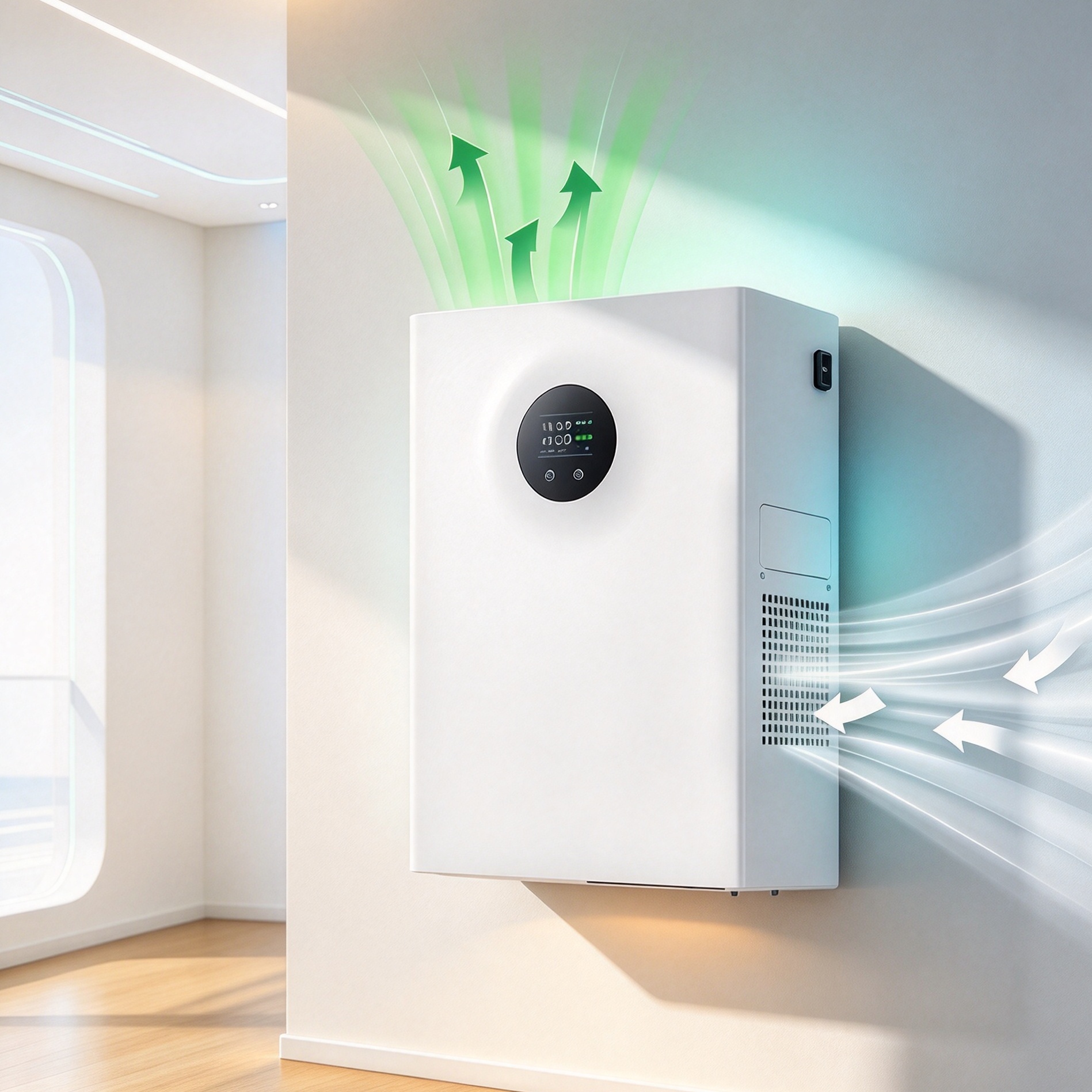
Size it, climate-match it, and judge efficiency, filters, noise and controls — a practical checklist for 2026A ducted ceiling-mounted ERV unit. Sizing and duct design matter as much as the unit itself. (Illustration)
An energy recovery ventilator (ERV) is one of the best upgrades you can make to a modern, airtight home — but only if you buy the right size and the right type. Too small and it cannot keep up with occupancy; too large and you waste money, energy, and often add unwanted noise. This guide walks through the seven checks that determine whether a ceiling-mounted ERV is the right one for your home.
The single most common mistake is choosing a unit that "feels about right." A properly sized ERV is sized to the ventilation rate your home actually needs. The widely used reference is ASHRAE Standard 62.2, which sets the continuous whole-house ventilation rate as:
Required CFM = 0.03 × conditioned floor area (sq ft) + 7.5 × (number of bedrooms + 1)
The floor-area term covers the volume of the house; the bedroom term accounts for the people living in it. Use this as your target continuous airflow, then choose a unit that delivers at least that CFM at its normal operating speed — not just its peak rating, which is measured with no ductwork attached.
Home size (conditioned) | Bedrooms | Target vent rate | Typical unit class |
|---|---|---|---|
~1,500 sq ft | 2 | ~65–70 CFM | 80–100 CFM class |
~2,000 sq ft | 3 | ~90 CFM | 100–130 CFM class |
~2,500 sq ft | 3 | ~105 CFM | 130–150 CFM class |
~3,000 sq ft | 4 | ~125–130 CFM | 150–200 CFM class |
A practical rule: pick a unit whose rated airflow at static pressure matches your duct design, and leave headroom — undersizing is the failure mode that can't be fixed later. If you have a large household, pets, or run the unit continuously, size toward the upper end.
Both devices recover heat from exhaust air, but they differ on moisture:
ERV (Energy Recovery Ventilator) transfers both heat and moisture through an enthalpy core. In humid climates it rejects excess moisture in summer; in dry seasons it helps retain moisture. Best for most temperate and humid regions.
HRV (Heat Recovery Ventilator) transfers heat only. It works better in very cold, dry climates where you do not want moisture added back in winter.
If you live somewhere hot and humid much of the year, choose an ERV. If you are in a cold, dry winter climate, an HRV is often the better match. Buy the wrong one and you'll spend years fighting humidity or dryness.
The headline spec is the energy recovery efficiency — the percentage of heat (and, for ERVs, moisture) recovered from the outgoing air. Good ceiling-mounted units recover 75–85% or more. Compare ratings at the relevant temperature range, since efficiency changes with outdoor conditions.
Then look at the motor. Modern units use DC/EC brushless motors, which draw far less power (often 25–40 W at high speed versus 70–100 W for older AC motors) and offer many more speed steps. A multi-speed DC motor lets you run quietly at low speed most of the time and ramp up only when needed — which is where the long-running energy savings come from.
ERV filters are rated by MERV (Minimum Efficiency Reporting Value). Match the filter to who lives in the home:
MERV 6: catches pollen and large dust — a baseline, not ideal by itself.
MERV 8: adds mold spores and finer dust — the minimum acceptable standard for most homes.
MERV 13 (≈ F7): captures smaller particles, smoke, bacteria and droplet nuclei — worth it for allergy sufferers, pet owners, or homes in wildfire-prone areas.
Make sure the unit actually accepts the filter grade you want, and check the replacement cost and availability — you will be changing these for the life of the system. A washable pre-filter plus a replaceable MERV 13 secondary filter is a strong, cost-effective combination.
An ERV runs continuously, so its noise sets the background sound of your home. Ratings are given in dB(A). As a rough guide:
Look for around 30–35 dB(A) at low speed for units near bedrooms or living areas — quieter than a whisper-soft library.
Install the unit in a closet, attic, or garage rather than a habitable ceiling when possible, and use flexible duct connectors to stop vibration traveling into the structure.
Compare the published sound rating, not just the marketing phrase "whisper quiet."
Controls range from a basic wall switch to fully automatic smart control. Choose based on how hands-on you want to be:
Manual / timer: simple and reliable; you set the speed or schedule yourself.
Auto humidity / CO₂ control: the unit ramps ventilation based on indoor conditions — convenient and efficient in a busy household.
Wi-Fi / app: remote monitoring, filter-change reminders, and scheduling from a phone.
Modbus / RS485: worth looking for if you are a builder, contractor, or integrating the unit into a Building Management System or smart-home automation.
More features are only worth paying for if you will use them. A timer model with good filters often outperforms an over-featured one with weak airflow.
A ceiling-mounted ERV needs supply and exhaust ducts routed to an outside wall or roof penetration, a dedicated power supply, and enough ceiling or closet space. Before ordering, confirm:
Clearance around the unit for service (filter and core removal).
Whether the unit needs a defrost function for very cold climates, where the core can ice up.
Duct length and bends — long, cramped runs reduce effective airflow and raise noise.
Washable vs. disposable heat-exchange core and expected service interval.
Calculated required CFM with the ASHRAE 62.2 formula and chosen a unit above that rate
Picked ERV for humid climates, HRV for cold-dry climates
Confirmed 75%+ recovery efficiency and a DC/EC multi-speed motor
Verified the filter grade (MERV 8 minimum; MERV 13 for allergies) and replacement cost
Checked the dB(A) rating for bedroom-adjacent installs
Chose a control scheme (timer / auto / Wi-Fi / Modbus) you will actually use
Confirmed clearance, duct routing, power supply, and cold-climate defrost
The right ERV ceiling fan is the one sized to your home's real ventilation need, climate-matched between ERV and HRV, and rated for the air quality and noise levels your household requires. Prioritize correct sizing, a DC/EC motor, and a serviceable filter first — then add smart controls only if they fit how you live. Get those fundamentals right and the unit quietly pays you back in fresher air, balanced humidity, and lower heating and cooling bills for years.
Sizing formula (ASHRAE 62.2: 0.03 × floor area + 7.5 × (bedrooms + 1)), MERV filter grades, recovery efficiency (75–85%+), DC/EC motor wattage and dB(A) guidance are drawn from publicly published HVAC industry, manufacturer and standard references (Panasonic, Ecohome, Talk of the House, ASHRAE 62.2), verified October 2026. Exact requirements vary by climate, local code, and installation.
 18705226241


