


ERV Ceiling Fan: Smart Ventilation for Better Indoor Air
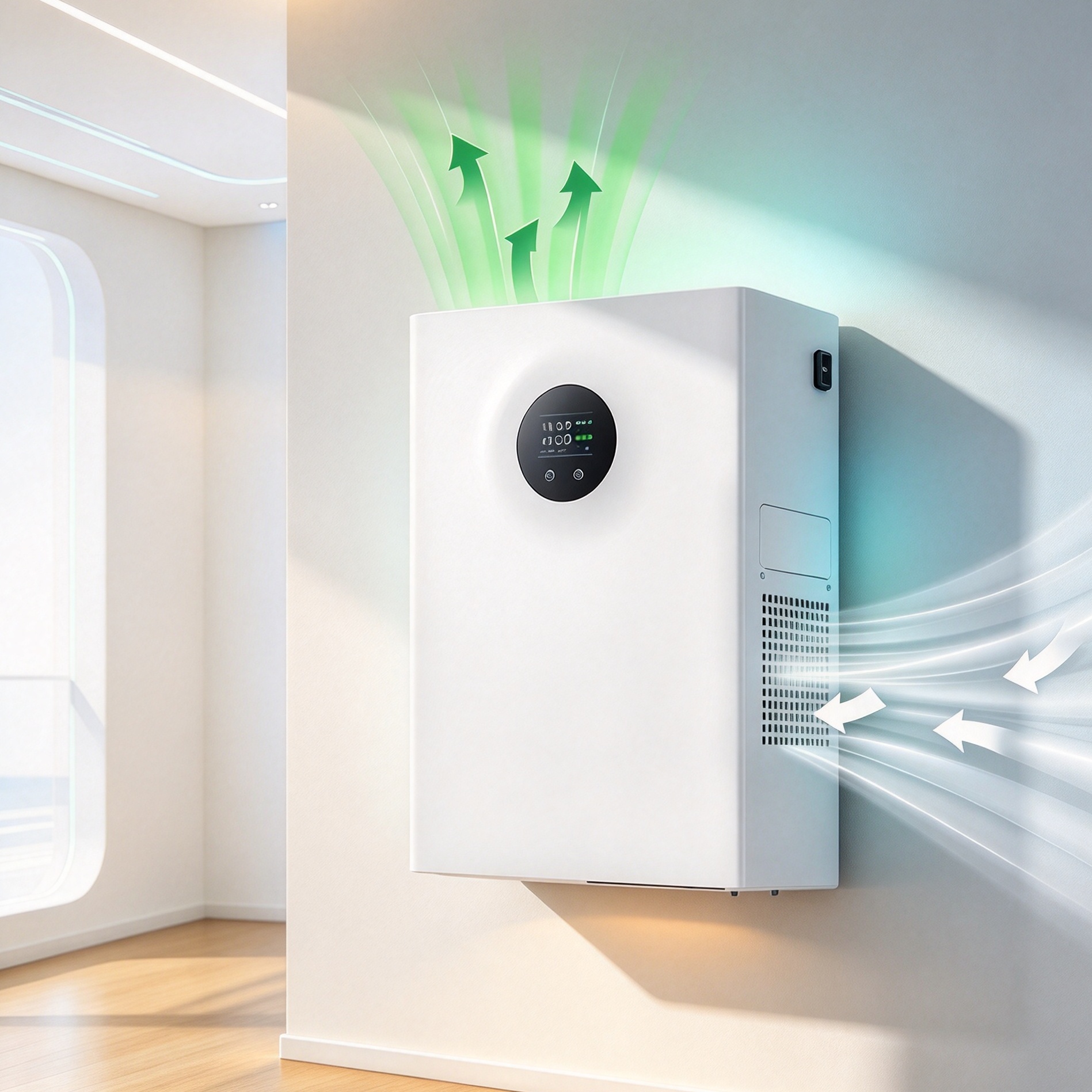
Energy recovery ventilation (ERV) has become the backbone of healthy indoor air in modern, airtight buildings. Among the many product formats on the market, the ceiling-mounted ERV fan stands out for how it packs a full balanced ventilation system — supply fan, exhaust fan, and energy recovery core — into a single unit that mounts flush in the ceiling plane.
This article looks beyond the sales pitch. We break down how the system physically works, the performance parameters that actually determine whether a unit performs well, how to size one, and the answers to the most common questions engineers and buyers ask.
A ceiling ERV unit contains three subsystems working together inside one compact enclosure:
Supply fan and exhaust fan — two EC or AC impeller fans that move equal volumes of air in and out, creating a balanced ventilation system.
Energy recovery core (exchanger) — typically a counter-flow or cross-flow plate exchanger, or a rotating enthalpy wheel. In an ERV, the core transfers both sensible heat and latent moisture between the two airstreams.
Filtration and intake/exhaust ports — a supply air filter (G4 standard, F7/H11/H13 optional) and outdoor/intake connections to ducting or wall grilles.
In a counter-flow plate exchanger, stale indoor air and fresh outdoor air flow in opposite directions through alternating channels. They never physically mix — the separating membrane transfers heat and, in the case of a moisture-permeable membrane, water vapor. This is what distinguishes an ERV from an HRV: an HRV transfers heat only, while an ERV's hygroscopic membrane also transfers humidity.
Not all ERV ceiling fans perform equally. When you read a datasheet, focus on these numbers:
Parameter | What it tells you | What to look for |
|---|---|---|
Nominal airflow (m³/h / CFM) | How much air the unit can supply and exhaust | Match to room volume and occupancy (see sizing) |
Heat recovery efficiency (%) | How much energy is recovered from exhaust air | 70% or higher on the rated airflow |
External static pressure (Pa) | How much duct resistance the fans can overcome | At least 50–100 Pa to handle real ducting and filters |
Supply/exhaust airflow balance | Whether the unit maintains balanced indoor pressure | Supply ≈ exhaust (small positive bias preferred) |
Noise level (dB(A)) | Acoustic comfort in occupied rooms | Below 30 dB(A) on low speed; check the distance/dB rating |
Filter grade & pressure drop | Cleanliness of supply air and fan load | G4 standard; optional F7/H11/H13; check replacement cost |
Power consumption (W) | Operating cost | Low wattage at nominal flow, e.g. 30–80 W |
Control interface | How the unit is managed | Multi-speed, wall controller, Modbus RS485, app or BMS integration |
Two units can look similar at the same airflow yet differ dramatically in real-world efficiency and noise once filters load and ducts add resistance. Always evaluate at the operating point, not just the nominal number.
Sizing a single-room or zonal ERV fan comes down to the ventilation rate you need, expressed in air changes per hour (ACH):
Calculate the room volume — length × width × height in metres.
Choose a ventilation rate — for living spaces, 1–2 ACH is a common target; bedrooms are often sized at 0.5–1 ACH or based on occupancy at ~30 m³/h per person.
Multiply volume by ACH — this gives the required airflow in m³/h.
Add a margin for filter loading and duct loss — size up by roughly 20–30% so the unit still meets demand as the filter ages.
For example, a 20 m² bedroom with a 2.6 m ceiling has a volume of 52 m³. At 1 ACH that is 52 m³/h; with a 25% margin, select a unit rated around 65–80 m³/h on low speed.
Balanced ductwork — keep supply and exhaust duct lengths and bends roughly equal to avoid pressure imbalance.
Condensate and drainage — in cooling or humid climates, an ERV may produce condensate; ensure a drain line and correct slope where required.
Frost protection — in cold climates, use a unit with defrost strategy or pre-heating so the core does not ice up in winter.
Filter access — choose a model whose filter can be removed from the occupied side without ceiling dismantling.
Commissioning check — after install, measure supply and exhaust airflow with an anemometer and verify balance before sign-off.
An HRV transfers heat only; an ERV also transfers moisture through a hygroscopic membrane. In humid summer climates, an ERV reduces the amount of humidity brought indoors; in cold dry winters it helps prevent over-drying. Choose based on your local climate and indoor moisture profile.
It provides continuous background ventilation and moisture removal, but it is not a substitute for a high-capacity intermittent kitchen extractor hood or bathroom extractor for peak steam and odor events. A combined approach — ERV for continuous balanced ventilation plus local extractors for peak loads — is recommended.
No. An EC-motor ERV unit typically draws 30–80 W at nominal flow — far less than the heating or cooling load it offsets. The energy recovered from exhaust air usually exceeds the fan's own consumption by a wide margin.
Roughly every 1–3 months for a G4 pre-filter and 6–12 months for F7/H11/H13, depending on outdoor pollution and run time. Regularly replace the pre-filter to protect the finer secondary filter and keep airflow up.
An ERV ceiling fan is a compact, balanced ventilation system that continuously replaces stale indoor air with filtered, energy-recovered fresh air — and does so in a package that fits unobtrusively into the ceiling. The key to a good investment is not the brand name but the numbers: recovery efficiency, static pressure capability, balanced airflow, noise, and filter options.
Evaluate the unit at its real operating point, size it with a margin for filter loading, and commission it properly. Do that, and a ceiling ERV fan becomes one of the highest-value upgrades for indoor air quality in any airtight building.
This article is for general informational purposes. Actual performance depends on the model, installation, ductwork, and climate. Sizing and selection should be performed by a qualified HVAC engineer.
 18705226241


