


ERV Buying Guide: Airflow, Efficiency, Noise and Control Options
Modern airtight homes and commercial buildings rely entirely on mechanical ventilation to maintain healthy indoor air quality (IAQ). Without proper ventilation, spaces accumulate stale air, excess moisture, CO₂ buildup, pollen, and airborne pollutants, leading to stuffy rooms, mold risks, and poor living or working conditions. Energy Recovery Ventilators (ERVs) stand out as the ideal solution, delivering continuous fresh air while recycling indoor energy to avoid sky-high HVAC costs.
However, not all ERV units deliver the same performance. For first-time buyers and HVAC installers, four factors determine 90% of an ERV’s real-world performance: airflow capacity, energy recovery efficiency, operating noise, and control options. This targeted buying guide breaks down these four critical features, helping you select a reliable, comfortable, and cost-effective ERV for residential and commercial applications.
Airflow, measured in CFM (cubic feet per minute) or m³/h, is the foundation of ERV performance. It defines how much fresh outdoor air the unit can supply and how much stale indoor air it exhausts every minute. Improper airflow sizing is the most common cause of unsatisfactory ERV performance.
Sizing should always follow space type, square footage, and occupant density, rather than overbuying for higher numbers. For standard residential homes, allocate 50–100 CFM per bedroom, plus supplementary airflow for living rooms, kitchens, and bathrooms to eliminate stagnant air. For commercial spaces including offices, classrooms, and retail areas, follow the industry standard of 15–25 CFM per person to ensure sufficient fresh air exchange for crowded environments.
An undersized ERV cannot dilute indoor CO₂ and pollutants effectively, leaving rooms stuffy and poorly ventilated. An oversized ERV wastes electricity, creates disruptive airflow drafts, and amplifies operating noise with no additional IAQ benefits. Always cross-check the unit’sactual delivered airflow (not just rated airflow) under real duct resistance for accurate sizing.
What differentiates ERVs from basic exhaust fans is their energy recovery capability. Top-tier ERVs capture and reuse heat and moisture from outgoing stale air, pre-conditioning incoming fresh air and drastically cutting heating and cooling loads. When evaluating efficiency, focus on two key metrics and overall energy-saving performance.
Total ERV efficiency combines sensible heat recovery and latent heat recovery. Sensible efficiency refers to temperature exchange, balancing hot and cold air to reduce HVAC temperature adjustment workload. Latent efficiency controls moisture exchange, the key feature that stabilizes indoor humidity year-round. It prevents overly dry air in winter and stifling humid air in summer, while inhibiting condensation and mold growth inside walls and ducts.
High-quality residential ERVs feature a total recovery efficiency of 65% to 85%, while commercial-grade models exceed 85% for large-space energy conservation. Units with higher efficiency ratings minimize long-term utility bills and maintain consistent indoor comfort throughout extreme weather seasons. For humid or mixed climates, prioritize models with superior latent recovery performance for balanced humidity control.
Many high-performance ERVs fail daily use due to excessive noise. Operating noise directly impacts livability in homes, offices, and quiet working environments. According to ASHRAE standards, indoor ventilation equipment should maintain noise levels below 45 dBA for optimal comfort.
Always check noise levels across different fan speeds, as low-speed daily operation determines long-term comfort. Ideal residential ERVs run at 30–40dB on low speed (whisper-quiet for bedrooms and studies) and no more than 55dB on high-speed boost mode. Premium models adopt insulated cabinet design and low-vibration EC motors to suppress airflow noise and mechanical resonance.
Avoid models with impressive CFM ratings but poor mute engineering. High airflow paired with loud operation leads to disturbed sleep, reduced work focus, and low user satisfaction. Remember: a quieter ERV runs more consistently, delivering better long-term IAQ than a noisy high-power unit that users frequently turn off.
Modern ERV control systems determine operational convenience, energy-saving accuracy, and intelligent ventilation performance. Basic manual controls suit simple spaces, while smart control systems are essential for modern high-efficiency buildings and complex commercial projects.
Entry-level ERVs feature manual speed adjustment (low/medium/high fan speed) and timing functions. These cost-effective options work well for small residential spaces with stable occupancy, allowing users to manually switch modes based on personal comfort and outdoor air conditions.
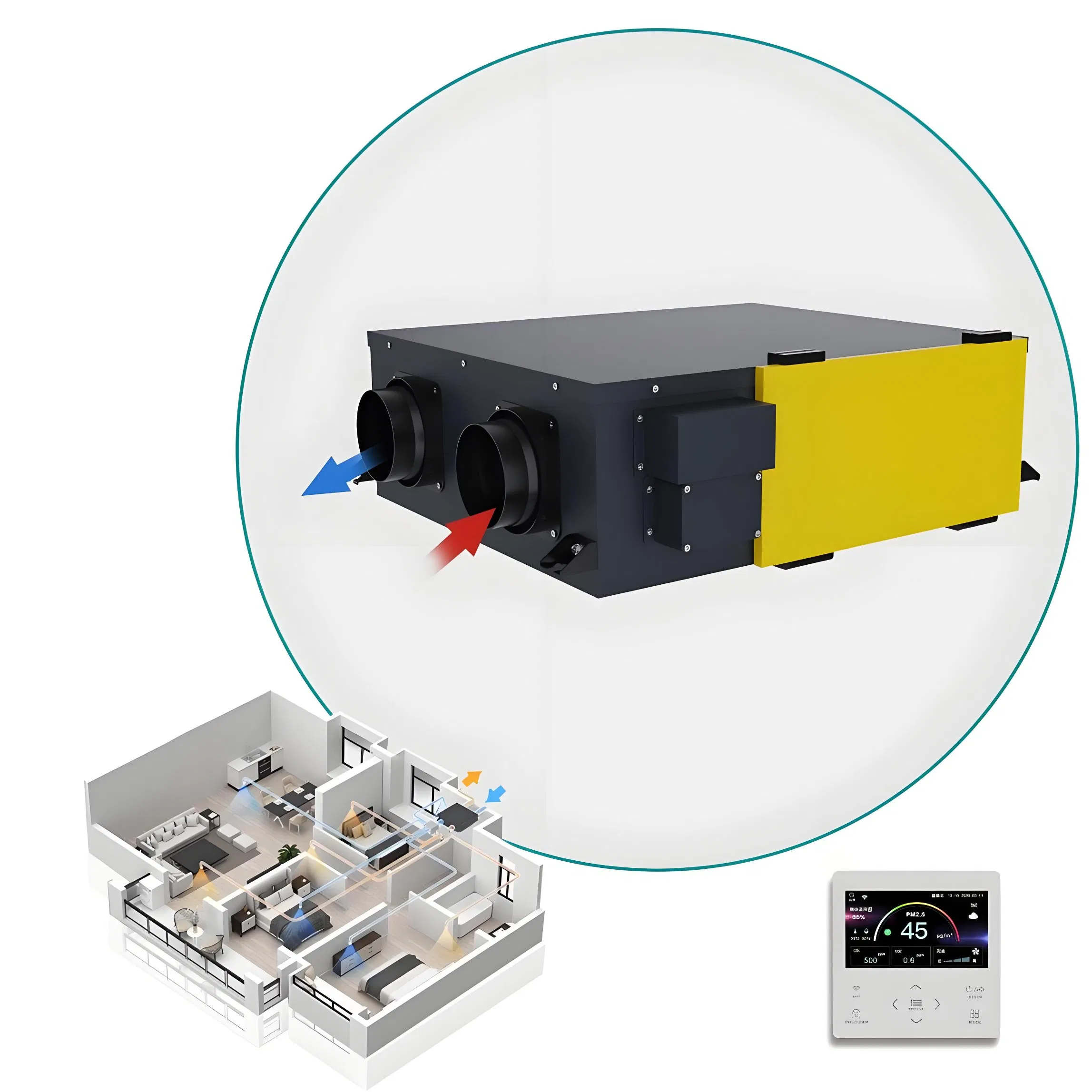
Premium ERVs integrate full smart control capabilities for automatic, sensor-linked operation. Key features include WiFi APP remote control, real-time monitoring of indoor PM2.5 and CO₂ levels, and auto-speed adjustment. When indoor CO₂ or pollutant concentrations rise, the system automatically boosts ventilation; when air quality is good, it switches to energy-saving low-speed mode.
Additional practical controls include scheduled operation, seasonal mode switching, and fault self-diagnosis. These functions eliminate frequent manual adjustments, ensure stable 24/7 ventilation, and further reduce energy consumption.
Use this concise checklist to shortlist qualified ERV models quickly:
Airflow: Sized accurately for room square footage and occupancy, no over-sizing or under-sizing
Efficiency: 65%+ total recovery efficiency for homes, 80%+ for commercial buildings
Noise: 30–40dB low-speed operation for quiet indoor environments
Controls: Manual speed control for basic needs; smart sensor-linked control for optimal comfort and energy savings
Choosing the best ERV is not about chasing the most advanced specs or the lowest price—it is about balancing airflow adequacy, energy efficiency, quiet operation, and practical control options. By prioritizing these four core factors, you can select an ERV system that delivers consistent fresh air, stable indoor humidity, lower energy costs, and long-term comfortable indoor environments for your home or commercial building.
 18705226241


