


Choosing the Right HVAC for Your Project: A Complete Project Guide
Every construction or renovation project boils down to one core goal: creating a safe, comfortable, and efficient indoor environment. Among all building systems, the HVAC system stands out as one of the most critical investments. It does not only control indoor temperature but also regulates air quality, humidity, and overall building energy performance. Many project owners and contractors make the mistake of selecting HVAC units based solely on upfront cost, leading to poor comfort, high energy bills, and frequent system failures in the long run. If you want your building project to deliver long-term value, choosing the right HVAC system tailored to your project is non-negotiable.
The HVAC system is the lifeline of any occupied building, whether it is a residential home, commercial office, retail space, school, or industrial facility. A mismatched HVAC system can trigger a series of costly problems. An oversized unit cycles on and off frequently, wasting energy and causing uneven temperature distribution. An undersized system runs nonstop, fails to maintain ideal indoor conditions, and wears out prematurely. Meanwhile, improper HVAC type selection can lead to poor ventilation, high humidity, poor indoor air quality, and even structural damage to the building.
On the contrary, a well-selected HVAC system aligns perfectly with your project’s size, usage, occupancy, and budget. It ensures consistent thermal comfort, healthy indoor air circulation, lower operational costs, and longer equipment lifespan. It also helps your building meet local energy codes and green building standards, boosting property value and user satisfaction significantly.
The first rule of HVAC selection is matching the system to your building type, as different spaces have completely different ventilation and temperature control demands. Residential projects prioritize quiet operation, energy efficiency, and simple maintenance, making split systems, heat pumps, and compact ducted HVAC systems the most ideal options. For commercial projects such as offices, shopping malls, and schools with high occupancy and large open spaces, centralized HVAC systems with powerful ventilation and balanced airflow are required to ensure uniform comfort for large crowds.
Industrial and special-purpose buildings, including warehouses, laboratories, and healthcare facilities, have stricter requirements. These projects need customized HVAC solutions with precise humidity control, high air filtration standards, and durable units that can withstand long-hour operation and harsh indoor environments. Tailoring HVAC systems to project usage scenarios eliminates overinvestment or insufficient performance issues.
Accurate heating and cooling load calculation is the foundation of correct HVAC selection. Many beginners simply estimate unit tonnage based on building square footage, which is an inaccurate and risky method. Multiple factors affect HVAC load, including building floor area, ceiling height, window insulation, wall materials, local climate conditions, indoor heat sources such as lighting and equipment, and average occupant density.
A professional load calculation ensures you select an HVAC unit with exactly the right capacity. It avoids the common pitfalls of oversized systems with short cycling issues and undersized systems that cannot meet peak seasonal demands. This step directly determines the system’s energy efficiency and operational stability throughout the building’s service life.
Modern building projects no longer focus only on temperature control; indoor air quality (IAQ) has become a core evaluation standard. A basic heating and cooling system cannot solve problems such as stale air, excessive CO₂, mold growth, and accumulated VOCs. For projects pursuing healthy building standards, it is essential to choose an HVAC system equipped with professional ventilation modules.
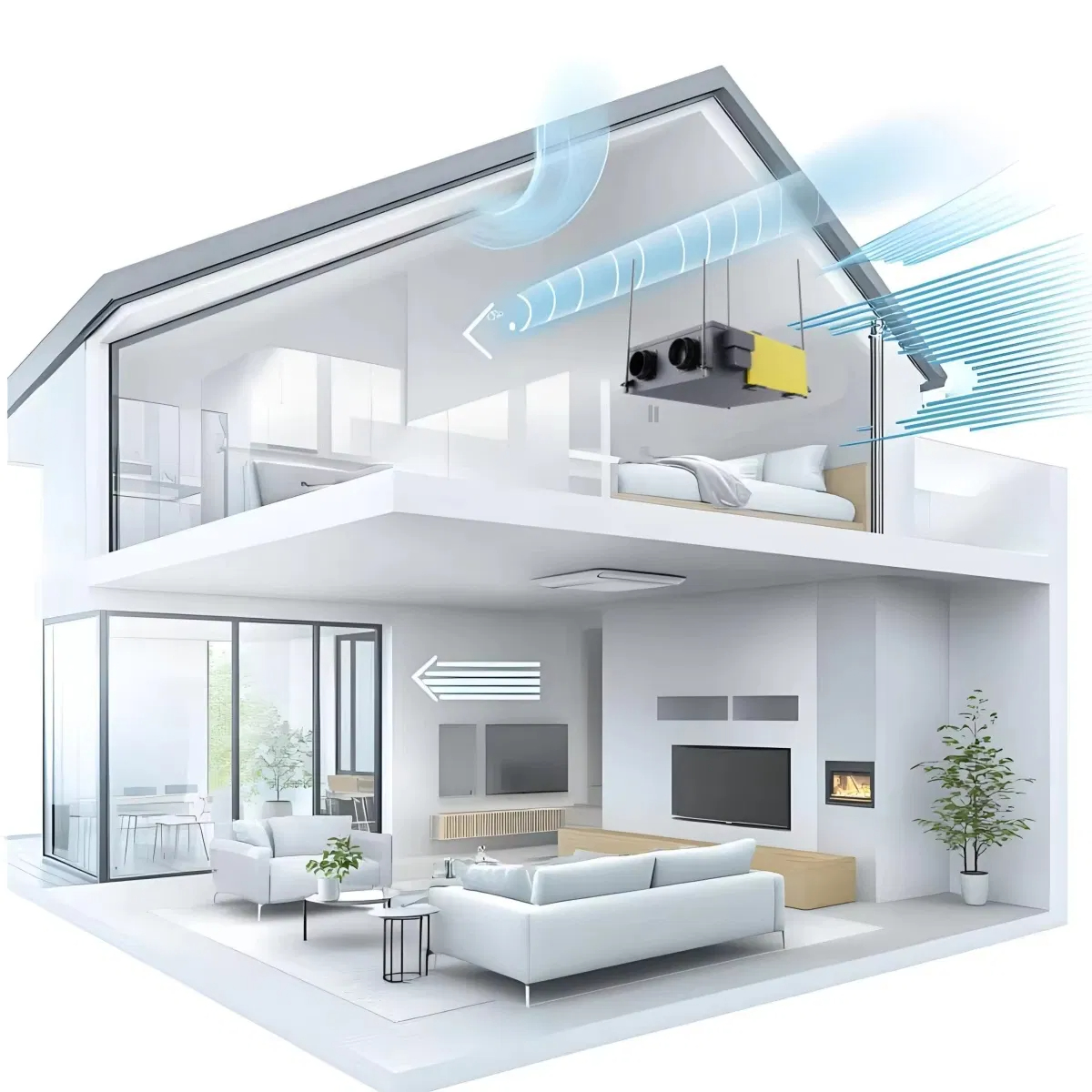
Heat Recovery Ventilation (HRV) and Energy Recovery Ventilation (ERV) systems are perfect upgrades for most residential and commercial projects. They realize efficient air exchange, filter outdoor air, balance indoor humidity, and recover energy from exhausted stale air, ensuring fresh, clean indoor air without extra energy consumption. For high-standard projects like hospitals and kindergartens, HVAC systems with high-efficiency filtration and disinfection functions are highly recommended.
Initial equipment cost is only a small part of the total HVAC investment. Long-term electricity bills and maintenance costs dominate the overall expenditure. High-efficiency HVAC systems with advanced inverter technology, smart control functions, and heat recovery structures have higher upfront costs but can cut annual energy consumption by 30% to 50%.
When selecting HVAC equipment, always refer to authoritative energy efficiency ratings. High SEER and EER rated units deliver stable performance with lower energy waste. Smart HVAC systems with automatic temperature adjustment, timed ventilation, and airflow monitoring functions can further optimize energy usage according to real-time indoor conditions, bringing sustainable cost savings for building owners.
Different HVAC systems have different maintenance thresholds and service lifespans. Complex centralized commercial HVAC systems require professional regular inspection, duct cleaning, and component maintenance, while split and packaged units feature simple structures and lower maintenance costs. For small and medium projects with limited after-sales budgets, choosing easy-maintenance HVAC solutions can effectively reduce later operational troubles.
In addition, consider the durability of equipment components. High-quality, weather-resistant HVAC units can adapt to extreme seasonal temperature changes, reducing failure rates and extending service life, which is especially important for projects in high-temperature, low-temperature, or humid regions.
Ideal for large residential villas, offices, and commercial buildings. This system delivers uniform heating, cooling, and ventilation through integrated duct networks, with low noise and high overall comfort. It supports whole-house air purification and humidity control, suitable for projects with high comfort and holistic air quality requirements.
Perfect for small residential spaces, single rooms, and renovation projects without pre-reserved ducts. It features flexible installation, low initial cost, and independent room-by-room temperature control, with simple daily maintenance and low energy consumption.
Best for healthy buildings, green homes, schools, and office spaces. Combining traditional temperature control with energy-saving ventilation functions, it solves the problem of poor indoor air quality while maintaining energy efficiency, fully complying with modern healthy building design trends.
Suitable for industrial plants, warehouses, and large open commercial spaces. The all-in-one design integrates heating, cooling, and ventilation, with powerful performance, strong environmental adaptability, and stable operation for long-duration use.
Choosing the right HVAC system is not about picking the most expensive or most advanced equipment—it is about finding the most suitable solution for your unique project. Always start with your project type, calculate accurate heating and cooling loads, balance upfront cost and long-term energy savings, and prioritize ventilation and indoor air quality to maximize building value.
A well-matched HVAC system turns an ordinary building into a comfortable, healthy, and energy-efficient space. Whether you are working on a new construction project or a building renovation, scientific HVAC selection is the first and most crucial step toward project success.
 18705226241


