


Animal Housing ERV System: Stable Air Quality for Livestock Welfare
Modern livestock farming is evolving rapidly, shifting from traditional extensive breeding to standardized, enclosed, and intensive farming models. For poultry farms, pig farms, cattle barns, and other animal housing facilities, stable and high-quality indoor air quality is no longer a secondary consideration but a core foundation of livestock welfare, healthy growth, and stable farm yields. Poor ventilation, harmful gas accumulation, and unbalanced temperature and humidity have long been the main culprits of low livestock immunity, frequent diseases, and slow weight gain. Today, the ERV (Energy Recovery Ventilator) system has become a professional and efficient ventilation solution for modern animal housing, delivering stable fresh air while maintaining a comfortable breeding environment and maximizing livestock welfare and farming economic benefits.
Most large-scale modern animal houses adopt fully enclosed thermal insulation structures to avoid the impact of extreme outdoor temperatures on livestock growth. However, this closed design seriously hinders natural air convection, resulting in a series of ventilation problems that restrict farm development. Unlike residential and commercial spaces, animal housing produces unique pollutants and harmful gases in high concentrations, which pose direct threats to livestock health.
During the growth and breeding process of livestock and poultry, a large amount of ammonia, hydrogen sulfide, carbon dioxide, and microbial aerosols are continuously generated from excreta, respiration, and bedding decomposition. If these harmful gases cannot be discharged in time, they will accumulate in the enclosed barn. Long-term inhalation of high-concentration toxic gases will damage the respiratory mucosa of livestock, reduce immune function, and easily induce respiratory diseases, infectious diseases, and eye inflammation. For young livestock with fragile physical functions, poor air quality will lead to high mortality and stunted growth, causing huge economic losses to the farm.
In addition, unregulated ventilation causes extreme fluctuations in indoor temperature and humidity. Excessively humid air breeds a large number of bacteria, molds, and parasites, while dry air irritates the respiratory tract of livestock. Traditional ventilation methods such as natural window ventilation and ordinary exhaust fans have obvious drawbacks: blind ventilation leads to severe temperature loss in winter and heat intrusion in summer, increasing the load of farm heating and cooling equipment and causing huge energy waste. It is difficult for conventional ventilation equipment to balance fresh air renewal, harmful gas discharge, and energy saving, making it a major pain point restricting standardized livestock farming.
The ERV energy recovery ventilation system is specially optimized for the high-demand ventilation scenario of intensive livestock farms. Relying on its core heat and moisture recovery technology, it realizes intelligent exchange of indoor and outdoor air, thoroughly solves the ventilation dilemma of enclosed animal houses, and creates a constant-temperature, constant-humidity, and fresh-air breeding environment for livestock.
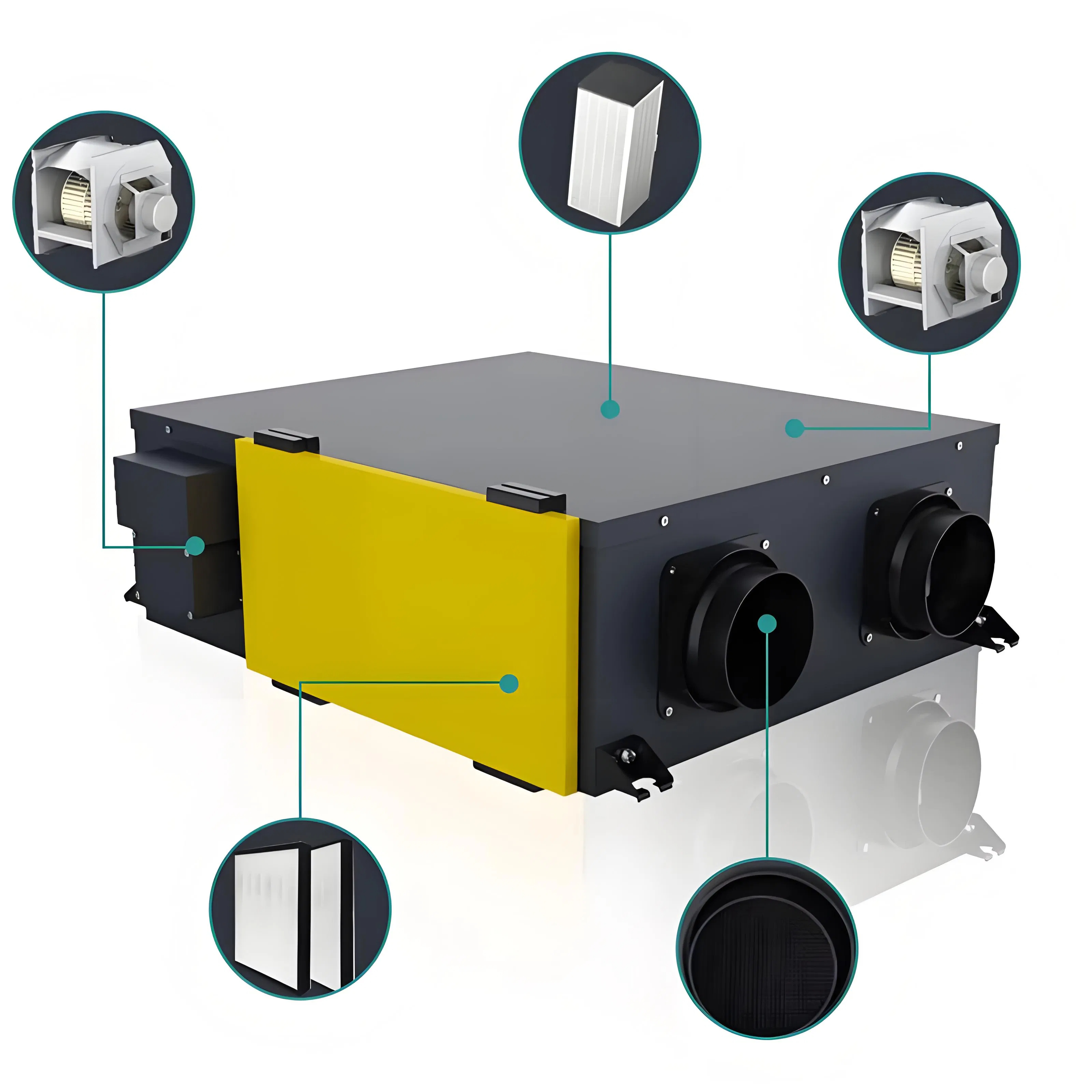
First of all, the ERV system supports 24-hour uninterrupted mechanical ventilation and efficient air purification. The equipment continuously exhausts harmful gases such as ammonia, hydrogen sulfide, and excess carbon dioxide generated in the barn outdoors, and quickly discharges humid and turbid air to reduce bacterial reproduction. At the same time, outdoor fresh air is filtered through multi-stage filter screens to block dust, pollen, outdoor bacteria, and suspended particles, ensuring that the air entering the animal house is clean and pollution-free. This continuous air circulation effectively improves the air freshness of the barn and eliminates the stuffy and pungent odor in the breeding space.
Secondly, the core energy recovery technology of ERV avoids the energy loss caused by traditional ventilation. The built-in high-efficiency heat exchange core can fully recover the sensible heat and latent heat of the exhausted indoor air, and transfer the heat and moisture to the incoming fresh air. In cold winter, it preheats low-temperature outdoor air to avoid the sharp temperature drop in the barn caused by cold air intrusion and prevent livestock from cold stress. In hot summer, it precools high-temperature outdoor air to maintain a cool and stable indoor temperature. While ensuring thorough ventilation, it effectively reduces the energy consumption of farm heating, cooling, and humidity control equipment, greatly reducing the long-term operating cost of the farm.
Moreover, the ERV system can achieve balanced humidity control for animal housing. It reasonably adjusts the indoor air humidity through moisture exchange, avoids excessive humidity that causes bacterial growth and livestock skin diseases, and prevents excessive dryness that leads to respiratory discomfort. The stable microclimate environment created by ERV lays a solid foundation for standardized and healthy breeding.
Clean air and low-harm gas environment are the key to reducing livestock diseases. The ERV system continuously removes harmful gases, bacteria, and dust in the barn, cuts off the spread path of airborne diseases, and effectively protects the respiratory health and immune system of livestock. Stable and comfortable growth environment reduces livestock stress response, significantly reduces the incidence of respiratory diseases and infectious diseases, and greatly improves the survival rate and healthy growth rate of young livestock.
Livestock living in a high-quality air environment have better appetite, stronger metabolism, and more stable growth status. Without the interference of turbid air and harmful gases, livestock can maintain efficient nutrient absorption and weight gain speed, shorten the breeding cycle, and increase the breeding density reasonably under standardized environmental conditions. For large-scale farms, the improvement of individual growth efficiency and survival rate directly translates into higher overall output and economic benefits.
Traditional ventilation brings huge energy consumption and frequent equipment maintenance costs. The high-efficiency heat and moisture recovery function of the ERV system can reduce the energy consumption of barn heating and cooling by 40%-60%, greatly saving the farm's annual energy expenditure. In addition, stable air quality reduces livestock disease incidence, cuts the cost of veterinary drugs and disease prevention, and avoids economic losses caused by large-scale sick livestock and death, realizing double savings in energy cost and breeding cost.
With the continuous upgrading of global livestock breeding standards, livestock welfare and green environmental protection breeding have become important assessment indicators for farm export and standardized certification. The fresh, constant-temperature, and low-pollution breeding environment created by the ERV system fully meets international livestock welfare breeding requirements. At the same time, efficient and low-energy ventilation reduces farm carbon emissions and pollutant emissions, helping farms achieve green and sustainable development and enhance market competitiveness.
Many farms still rely on natural ventilation and ordinary exhaust fans, which cannot adapt to intensive enclosed breeding modes. Natural ventilation is affected by weather and seasons, with unstable ventilation effect and inability to control temperature and humidity; ordinary exhaust fans cause serious energy loss and cannot filter air pollutants, which is difficult to meet high-standard breeding needs. Air purifiers can only filter air but cannot discharge harmful gases and cannot realize air circulation renewal.
Compared with traditional equipment, the ERV system integrates fresh air supply, exhaust gas discharge, air filtration, constant temperature and humidity control, and energy recovery in one system. It is professionally customized for the high-pollution and high-ventilation-demand scenario of animal housing. The equipment runs with low noise, will not cause stress interference to livestock, and supports long-term stable continuous operation. It can also flexibly adjust the ventilation volume according to the barn area, breeding density, and seasonal changes, fully adapting to the breeding needs of pig farms, cattle barns, poultry houses, and various livestock and poultry breeding spaces.
Modern livestock farming has bid farewell to the extensive mode of "relying on the sky to breed", and refined environmental control has become the core of improving breeding efficiency and livestock welfare. Stable air quality is the invisible guarantee for livestock health and farm profits. The ERV animal housing ventilation system perfectly solves the ventilation pain points of enclosed farms, efficiently removes harmful gases and pollutants, creates a constant and comfortable breeding microclimate, reduces livestock diseases, improves growth efficiency, and saves farm energy costs.
For farms pursuing standardized, green, and high-efficiency breeding, investing in an ERV energy recovery ventilation system is not only an upgrade of breeding environmental equipment, but also a key investment in improving livestock welfare, stabilizing breeding output, and realizing long-term sustainable development of the farm.
 18705226241


